






Bridging Waterborne and Solvent-Borne Chemistries to Reduce Cost and Complexity in Concrete
Hey, I’m Ramon Lozada, Global Product Manager for Coatings & Inks at Penn Color. A recurring theme in my conversations with customers in the concrete coatings space is the unnecessary complexity created by “double inventory” – with formulators managing separate colorant lines for water-based and solvent-based coatings.
In this case, one customer approached us facing that exact challenge. Their warehouse was carrying high inventory costs, overflowing with separate SKUs for waterborne and solvent-borne colorant lines. In the lab, their team was spending countless hours in R&D, repeatedly forced to compromise between the ease of water-based systems and the rugged durability of solvent-based topcoats – simply because one system couldn’t deliver both. This approach also increased risk: in the lab, through pigment float and other compatibility issues; and in the field, with the constant concern of using the wrong SKU on a high-stakes job. As their product portfolio expanded, this “double inventory” model had become untenable.
As always, we started by listening. We asked a focused set of questions to understand exactly where their current approach was breaking down – where color issues appeared most often, which chemistries posed the greatest challenges, and which performance requirements were non-negotiable for concrete applications, whether in high-pH environments or on high-exposure exterior slabs. They also stressed the need for seamless integration with existing fluid management systems to ensure accurate, repeatable dispensing.
Those conversations made it clear that traditional colorants typically fail because pigment treatments and dispersants are often “locked” into either polar or non-polar systems. Inconsistent batch-to-batch density and viscosity further complicated automated dispensing, leading to color variation and material waste. At the same time, we were able to define what the ideal solution for the high-alkalinity world of concrete should look like: a single colorant system that delivered increased durability while remaining fully compatible with both polar and non-polar applications – with tight control of key physical properties to support dispensing accuracy within ±2%.
With that development framework in place, our technical teams identified an opportunity to leverage the strengths of two proven technologies within the Penn Color ASTRAD™ portfolio. ASTRAD™ IS (solvent-borne) and ASTRAD™ WB (waterborne) each perform exceptionally well within their respective chemistries, but the key challenge was finding a way to bridge the gap between them. We also addressed applicator experience in water-based systems by prioritizing low VOC content and minimizing ammonia odor.
By closely evaluating dispersant systems, pigment treatments, and carrier vehicles from both platforms, we engineered a solution specifically designed to meet the customer’s cross-chemistry needs. We solved the compatibility puzzle by creating a universal vehicle capable of accepting Complex Inorganic Color Pigments (CICPs). This meant the customer no longer had to sacrifice the toughness of inorganic pigments for the convenience of a unified color system, while achieving consistent viscosity and density for reliable dispensing and repeatable color results.
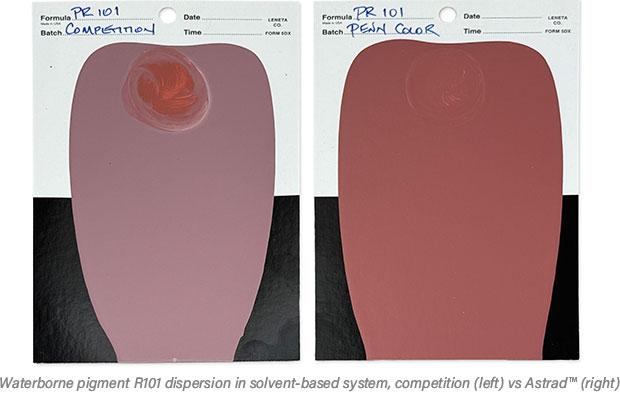
As the solution moved from development into use, the customer saw the impact firsthand: a 50% reduction in inventory, consistent color performance across their full range of coating systems, elimination of field-related compatibility issues, improved durability, and significantly reduced lab time, and smoother integration into existing dispensing processes — alongside a lower-odor, lower-VOC experience in water-based formulations.
At Penn Color, this is how solutions come to life – by listening to our customers, understanding the realities of their processes, and working side-by-side to build answers around their needs. When we listen first and design with purpose, we’re able to turn complexity into clarity and deliver solutions that perform where it matters most.
